

As global supply chains undergo strategic reorganisation, Central Asia is emerging as one of the most compelling destinations for Chinese private enterprises expanding overseas, with Kazakhstan positioning itself at the heart of this shift.
By Professor Winnie Qian Peng • 4 min read
Adapted from an article first published in Chinese in the Hong Kong Economic Times (香港經濟日報) on 7 August 2026: 港哈高效聯動 助內企拓中亞樞紐.
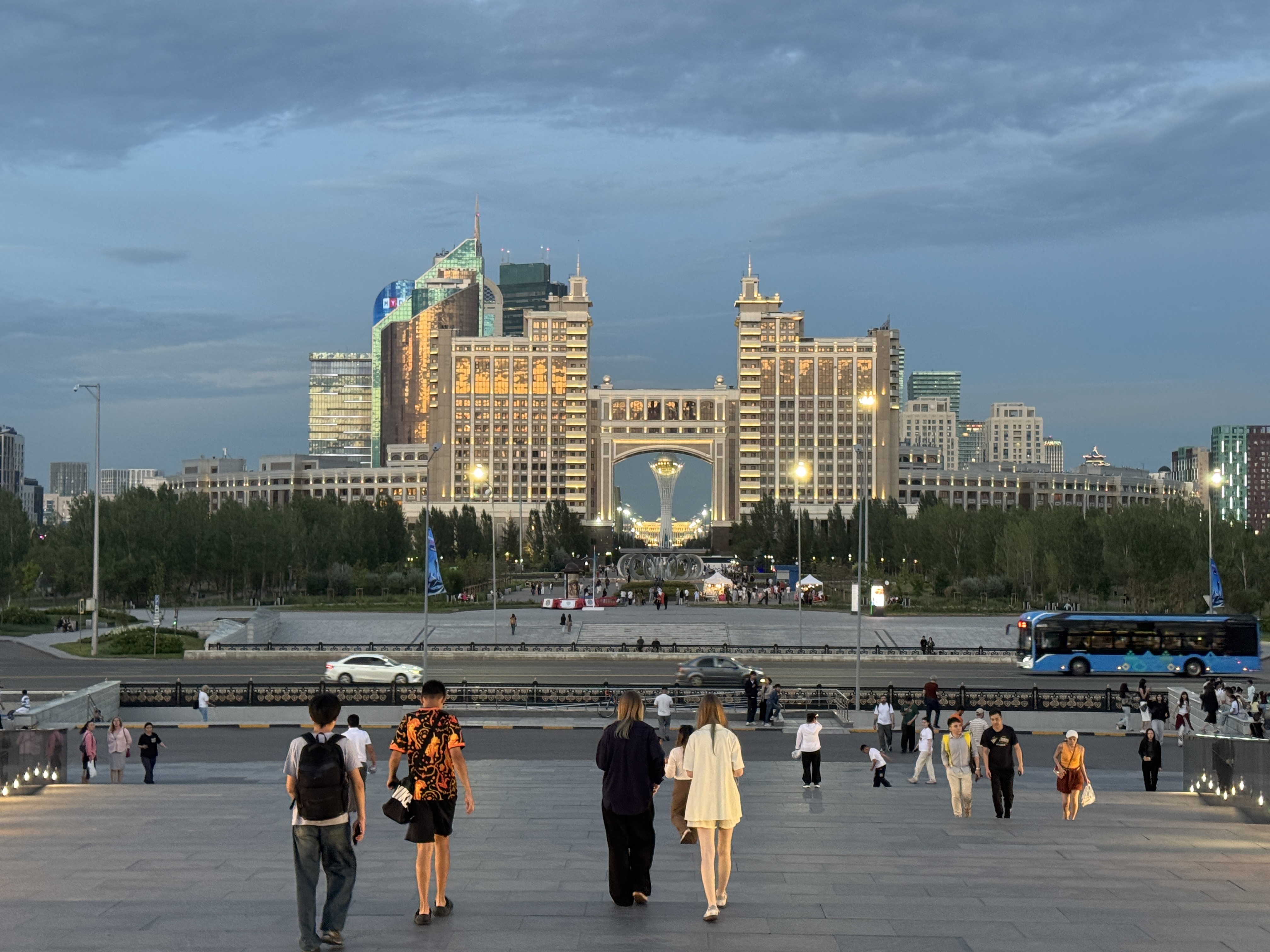
In early July I was invited to deliver a two-day module on family succession and governance for an international executive programme in Astana. What follows are my observations from the trip, together with an interview I conducted with Jiaxin International Resources, a Chinese private enterprise operating in the country.
Why Kazakhstan
Kazakhstan is the largest economy in Central Asia and a natural land bridge across Eurasia. With a territory of 2.72 million square kilometres and a population of roughly 20 million, it combines exceptional resource endowments — oil, gas, uranium and significant rare earths — with a fertile northern agricultural belt long known as the region's granary.
Kazakhstan at a glance
| Land area | 2.72m km² |
|---|---|
| Population | ~20m |
| GDP per capita | ~US$15,000 |
| Chinese firms operating | 8,500+ |
| Cumulative Chinese investment | >US$30bn |
Figures as of 2025.
GDP per capita has reached about US$15,000, supported by universal free healthcare and education, a capable workforce and healthy consumer spending. A wave of reforms under President Tokayev — anti-corruption measures, curbs on entrenched monopolies and a push toward digitalisation — has further improved the business environment.
The composition of Chinese investment has changed markedly. In the 1990s, entrants were mostly large state-owned enterprises concentrated in energy and infrastructure. In recent years, as market access has widened, privately owned Chinese companies have arrived in force: more than 8,500 Chinese firms now operate in the country, with cumulative investment exceeding US$30 billion. Walking through Astana — a modern, purpose-built capital — and then out into the provinces, one is reminded of the energy and momentum of China in the early reform era.
A pioneer's playbook: Jiaxin International Resources
A compelling illustration of how a private enterprise can take root overseas is Jiaxin International Resources (3858.HK / JXIR.AIX), led by its founder and chairman, Mr Liu Liqiang. Among the earliest Chinese private entrants into Kazakhstan's mining sector, Liu moved quickly when the country opened controlling stakes in mining rights to foreign investors. He led a survey team to Kazakhstan in late 2013 and formally established the company in 2014. Eleven years of perseverance turned its Bakuta project — roughly 180 kilometres east of Almaty, near the Chinese border — into a globally significant tungsten operation, and, in August 2025, into a company listed in both Hong Kong and Astana. According to Frost & Sullivan data cited in the company's listing documents, Bakuta was as of end-2024 the world's largest open-pit tungsten mine by tungsten trioxide (WO₃) mineral resource, and the fourth largest tungsten mine overall including underground operations.
Two key lessons from the Jiaxin venture
1. Mixed-ownership synergy. Rather than going it alone, the founding team's private company, Hengzhao International, partnered with state-owned enterprises — Jiangxi Copper and China Railway Construction — to develop the project through Jiaxin as a mixed-ownership venture. The private partner supplied market agility and fast decision-making, while the state enterprises brought engineering scale, technical standards and rigorous compliance. Liu notes that the model was subsequently cited by China's National Development and Reform Commission as a demonstration case for mixed-ownership cooperation.
2. Strategic capital innovation. In August 2025, Jiaxin completed a simultaneous listing on the Main Board of the Hong Kong Stock Exchange and the Belt and Road board of the Astana International Exchange (AIX) — the first company to do so, and the first renminbi-denominated share issue in Central Asia. The move activated offshore renminbi liquidity and offers a replicable template on two fronts: a route for other outbound Chinese enterprises to draw on two capital markets at once, and a roadmap for Kazakhstan's own resource companies to list in Hong Kong — reinforcing Hong Kong's role as a diversified international fundraising centre.
Four practical recommendations
From more than a decade of cross-border operation, Liu offered four candid recommendations for private companies eyeing Kazakhstan, and Central Asia more broadly:
01 Take compliance and due diligence seriously
Don't cut corners on legal and financial advisers. Understand a target's history, ownership and finances thoroughly, and follow local law and procedure to the letter.
02 Keep your word
Local business culture places great weight on contracts and commitments. Always deliver on what you promise — consistency is what builds lasting trust.
03 Communicate directly
In negotiations, be candid and straightforward, clearly marking the boundaries of what is and isn't feasible. Doing so raises efficiency for both sides.
04 Respect the culture
Kazakhstan blends firm rule-of-law expectations with a warm, relationship-oriented culture. Operate strictly by the rules, but engage sincerely, respect local customs and integrate into the community.
The Hong Kong bridge
A recent Hong Kong delegation to Kazakhstan produced a broad set of cooperation agreements, including a memorandum of understanding between Hong Kong Exchanges and Clearing and the Astana International Financial Centre (AIFC). Hong Kong can offer Central Asian companies IPO and debt-financing channels, and the two sides are exploring a gold and base-metals trading hub that would connect directly to Kazakhstan's resource base.
The AIFC operates under a common-law framework and launched a dedicated family office regime in 2024. As Asia's leading family office hub, Hong Kong has deep experience in family governance, trust structures and succession planning — precisely the capabilities Central Asia's first-generation entrepreneurs now need as they diversify their financing and confront the question of global asset allocation for the first time.
What travels
The Jiaxin story suggests that success overseas is less about timing a single market window than about disciplined execution — staying close to regional trends, insisting on compliance, and innovating on both structure and financing. For family businesses considering a path abroad of their own, Kazakhstan is a reminder that new markets reward patience, partnership and a genuine willingness to operate by local rules, with Hong Kong well positioned to serve as the bridge.
This English article is adapted from a Chinese-language commentary by Professor Winnie Qian Peng first published in the Hong Kong Economic Times on 7 August 2026. Company data and operational claims are drawn from public filings and from the author's interview with Mr Liu Liqiang. Views expressed are the author's own.

Professor Winnie Qian Peng
Director, Roger King Center for Asian Family Business and Family Office Research
HKUST Business School
Professor Peng's research focuses on family business management, succession planning, governance and family values for family enterprises in Asia and around the world.